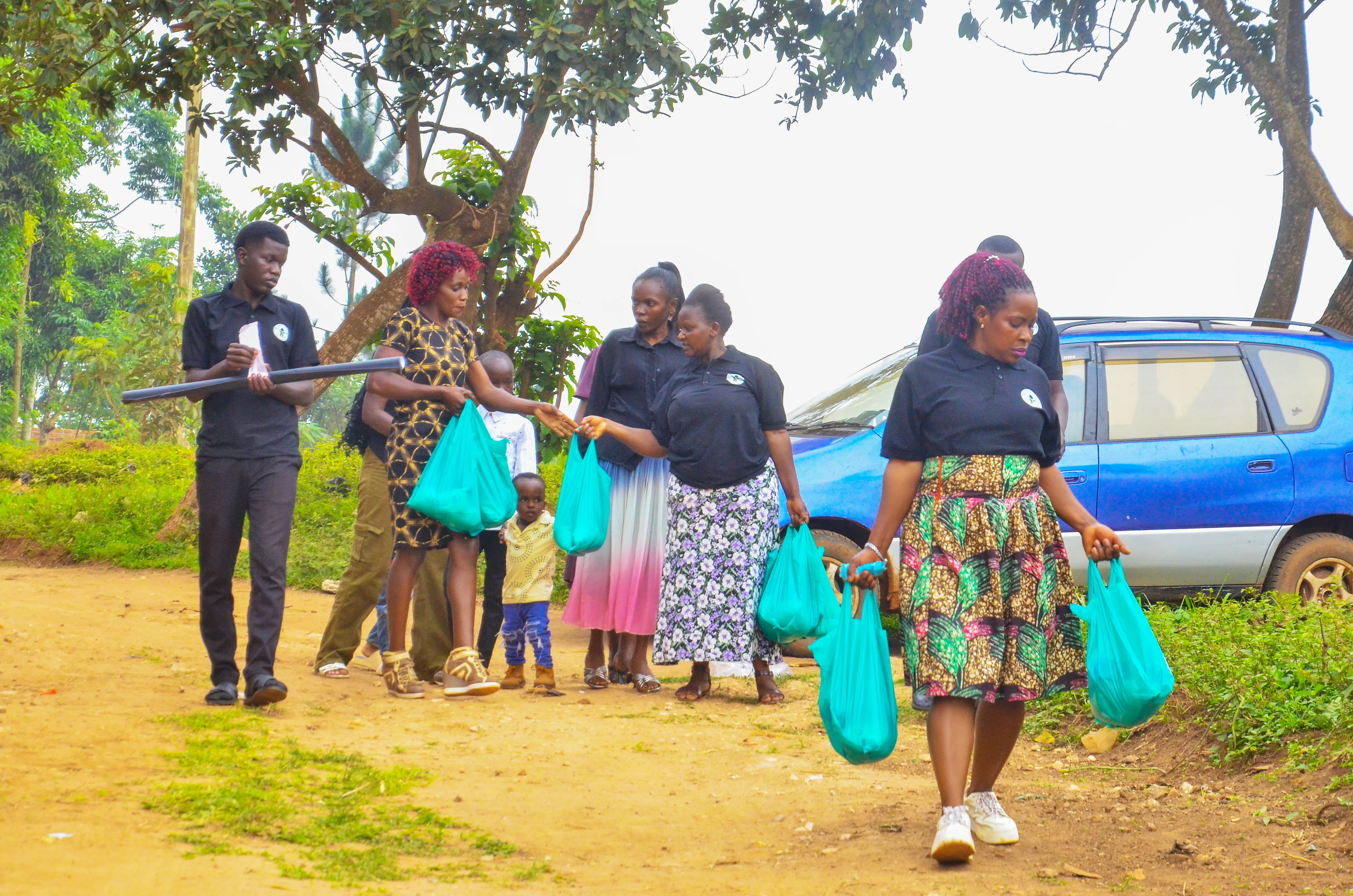
The vehicle stops where the road stops. Everything after that is carried.
There is a reason we do it this way rather than asking families to gather at a central point. A public queue turns a hard week into a humiliation, and the households in the greatest difficulty are frequently the least able to walk to a collection point in the first place — the elderly, the unwell, a mother with three children under five.
So the team walks. Two parcels per person, sometimes three, along footpaths that turn to red clay after rain.
The list of who receives what is drawn up in advance with the local council chairperson, who knows which roof leaks and which grandmother is feeding four grandchildren on one garden. We check the list ourselves before we travel, and we correct it afterwards.
It is slower than the alternative. It is also the only version of this work we are prepared to do.